
- August 2, 2005: Planes, Trains, and Automobiles, Part Deux (getting back to El Salvador, really)
- August 2 - 3, 2005: Back to our home
- August 6 - 20, 2005: Amy goes to school
- August 14, 2005: Joe and the volcano
- August 21, 1005: Back home
August 2, 2005: Planes, Trains, and Automobiles, Part Deux (getting back to El Salvador, really) 32d54'11.26"n, 80d02'56.49"w (you should be able to just copy these new coordinates into Google Earth to find us)
Having been to Charleston AFB a week earlier made it easy for us to find our way around the base and rental car return process.
We knew that there was a Hooter's near the base and figured out how to get to it, so instead of settling for an barely-edible Chinese buffet, we had our old favorite of Buffalo Wings from Hooter's. They really do have the best wings. I have to agree. (Amy) To our surprise all the girls had on camouflage shorts instead of their usual orange. About the time we started to ask about them we noticed that Monday's is Military Night. Anyone with a military ID got 10% off. What a treat! We could not resist stuffing ourselves. Amy was able to get her Sweet Ice Tea (something only the South can make), and I had a decent last meal in the states.
We were worried about all the things we had in our luggage making it through the airport security and customs. The biggest problem was carrying four large suitcases, two backpacks and a computer case. We were fortunate that we had to carry it for only a hundred yards or so total.
Let me just say (Amy, here, back again to my journal duties) that I really enjoy flying with the military, being on military bases, etc. It's great to see all these folks serving our country, keeping us safe, free, etc. I get really emotional even thinking of it. What sacrifices. But I'm off point. I've enjoyed the couple of the flights we've made with them, but this last one was the best. Absolutely amazing. The flight crew, to include Pete and Michelle, was great. They were playing flight attendants today. 50% of their time is spent flying personnel and cargo. The other 50% is spent on refueling missions. I'm guessing that they prefer refueling. But they do the other job with much grace and honor. Pete, the head guy of the non-cockpit crew (I'm sorry, I have no concept of hierarchy in Air Force), called my name and one other guy's name before the flight. What have I done now, I'm wondering. But it was just a random offer to sit in the cockpit during takeoff and landing. What a treat!!!
Right before taxi, I was escorted to the cockpit, introduced to two Majors (pilot and copilot) and the navigator (don't know his rank). I got a set of headphones to listen to flight control and sat back to enjoy the show. Pete was in the cockpit to make the announcement to the passengers to stay seated, yada, yada, yada. He also had some other responsibilities telling the ground that we had pushed off, etc. It has been 6 years since I've been in a cockpit. A major reason we sold the plane (other than to get the boat) was that we weren't flying it in California. We were a long was from the airport where we kept it, and we didn't fly often enough to be safe. We were "current" under FAA rules, but didn't feel current enough to handle emergencies if they arose. We also haven't jumped in many years. In large part, we didn't enjoy as much the drop zones near us in California. Without the family-like atmosphere we enjoyed in Texas at our favorite drop zone and with all the time we put into the boat, we hadn't jumped in ages. When you fly planes or skydive you see large views of the sky. Wide-open spaces. Nothing like looking out an itsy bitsy, teeny weeny window on a commercial flight. It's absolutely gorgeous to see wide expanses of blue. It was incredibly moving. I'd forgotten how breathtaking it is up there. And I was amazed at how much of flying came back to me. When listening to air traffic control with the speed and code-words used to tell you to go this direction or that altitude or to change frequency to a different flight controller, I was amazed at how much I still picked up and decoded. The pilot turned to the copilot at one point because she hadn't heard what altitude we'd been cleared through. I knew the answer I was quite impressed with myself. Unlike Hermione Granger (bit of Harry Potter for you), I didn't raise my hand. Back in my seat I told Abe how much I truly missed skydiving and flying. When we get back from our boating adventure, we'll get back into it.
The excitement wasn't over. Pete offered to show any of the passengers who wanted to visit the back of the plane to see the refueler. Abe and I were the only takers. The passengers are separated by all the cargo by a tarp. We had to go behind the tarp all the way to the back of the plane, a KC-10. It's immense! I didn't get an idea of the size because the tarp hid so much of it. Amazing. Pete gave us a bunch of specifics of how much weight it can hold, how fast it can refuel, etc. We sat in the butt of the aircraft and got to open the window (kind of like the flap on those union suits that tv shows hillbillies wearing - the butt flap) to see the picture they have when refueling planes. It was so incredibly cool. And they can refuel two fighters at one time if needed. How cool is that?! They get anywhere from 6' to 22' from the planes they're refueling.
Here's the view we had (minus the honking huge plane flying behind us
and the boom): 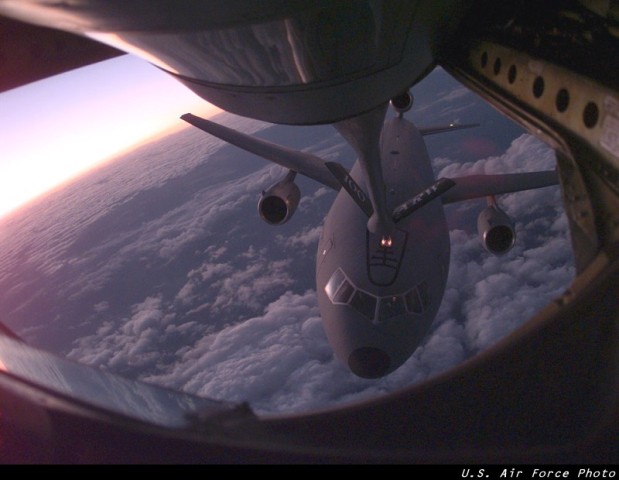 More pictures here
if you're interested.
More pictures here
if you're interested.
Our crew was actually Air Reserves. They'd been to Iraq a couple of times, but only for a month at a time. One of the lady sergeants said she thought that didn't really count since it was for such a short time. I said it did count and that we appreciated it. She said they would fly around on refueling missions for hours and see the same fighters come back 2 or 3 times for more fuel. And since they're so close, she could see the munitions on board the fighters lessening with each return trip. Amazing people, those who serve. "Thank you" is so inadequate! Back to the top.
August 2 - 3, 2005: Back to our home 13d15'45.06"n, 88d29'24.5"w
The trip back to the boat was much quicker because we knew what we were doing this time and were certain about the bus schedules and such. We knew that much of the traveling we wouldn't have to be hauling our bags - except arriving at the base in Honduras. We would have to carry our 7 bags from the terminal to the bus stop on base. It wasn't far, but it was long enough! The bus on base carried us to the front gate where we hailed a taxi. For $40 USD, we were packed into the taxi with our luggage (little room left for people) and off we went. This was a new adventure because none of the gauges in the car worked. No idea how fast we traveled, no idea how much gas we had - nada. Fortunately our driver was a slow driver and I think we did about 35 mph for the entire drive back. It was a 1 hour drive going and a 2 hour trip back. Better that way then 1 hour going and 30 minutes coming back, I guess. We had to stay at a hotel in Tegucigalpa because the bus to El Salvador only left once a day at 6 am. We had our last night in an extremely comfortable bed with loads of room, before heading back home.
The biggest problem with our luggage almost came about because we wanted to make sure that so many suitcases would not be a problem on the bus from Honduras to El Salvador. As we made reservations for the next morning's bus, the lady at the counter became concerned that we might have something that might not be allowed through customs in El Salvador. She told us to tell the driver what we had in them and he would decide if we could take it on the bus. We opted to apply the ignorance rule and just not tell the driver what we had. He did ask what we had in the makeshift bag (the insulation for the refrigerator), but was ambivalent about the other bags. When we got to El Salvador we found a couple of the bags unzipped, but all the items inside were intact.
Crossing borders for us is stressful. For Abe because he's trying to understand Spanish with loads of other noises happening all around, and if he didn't hear them the first time, he can't ask me what they said because I don't speak Spanish. For me it's stressful because I imagine that they'll be holding us up asking why it is exactly that we want to visit, where we're going, etc. And going into Honduras, they wouldn't let Abe translate for me. Something about not having any help from others. They speak so very quickly here (much faster than in Mexico), and with all the noise at the border, I had a very difficult time. We were both a bit stressed. We made it okay, but were made to wait to get a tourist visa this time (not sure why not when we cleared in at Barillas Marina) but for $10 each, we were cleared for 90 days in El Salvador. The first time it was free. Maybe that explains why. Free. $10. Guess which one they'll most likely pick.
There's something about crossing the border at a run-down building that isn't very clean, men offering every other step to change dollars to lempiras or visa versa (at an extremely poor exchange rate), ladies pushing to get in front of you to offer you food for sale. I like my personal space and it has been violated both times we've crossed here. If you're not right on top of the person in front of you, someone will cut line. Get out of my SPACE!!!! And don't touch me!!!!! Don't breath on me!!! Don't talk to me!!! And don't look at me!!!! I am not a freak at 5'9", blond hair and blue eyes. Just a slight bit testy. And this time, Abe was particularly stressed because he thought we were the only ones that needed to check in. If you're from a Central American country, there is no need to clear the boarders. The bus employees check passports and instructs who needs to clear through. Abe didn't see anyone else get off the bus and was extra stressed (we weren't the only ones, but he didn't know that). Anyway, we made it through okay this time, and I sighed a big sigh.
We all boarded the bus and took off. But the bus pulled over into an empty parking lot with Customs officials. Abe and I looked at each other and crossed our fingers. A couple of people were asked to get off the bus (we now assume it was to unlock luggage), but we were relieved they didn't bother us. With insulation, electrical wire, creeping crack cure (liquid epoxy - just what you were thinking, right?), 6 D rechargeable batteries, paint, varnish, books, book lights, citronella candles, hand planer and sharpener, CD/DVD cleaner, cassette cleaner, car reflective shades (no, not for our nonexistent car but for our refrigerator), pen refills, fuel pump for gen set, fabric cleaner, digital speaker for our Ham radio, shower hose and sink adapter, cable for our radar/autopilot, Benadryl spray for itches, business cards, hanging sun shower, gasoline biocide, Oxy clean for laundry, lug nuts, knob for lid of grill and some handkerchiefs we were slightly worried that something might not make it. Customs did go through the bags (at least a cursory review), but no issues. Thank goodness.
The bus dropped us in San Salvador at 12:30 and we hightailed it to the bus station for the chicken-bus ride back to Usulutan.
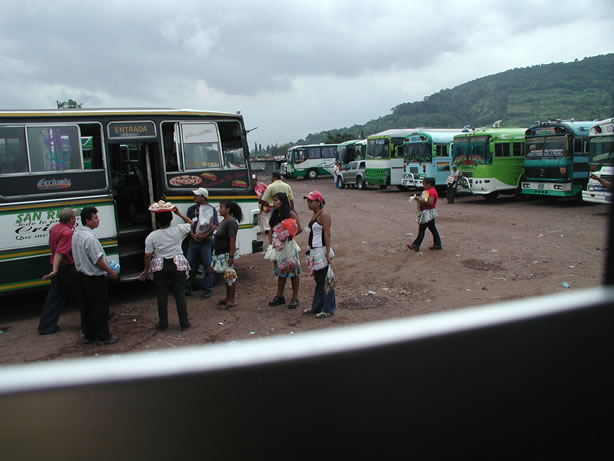 This depot is absolutely nuts. People screaming for you to take their
bus, selling food and drinks. Nuts.
This depot is absolutely nuts. People screaming for you to take their
bus, selling food and drinks. Nuts.
We were lucky to get a "Especial" which meant it didn't stop every 2 minutes along the way back. 2 1/2 hours from Usulutan to San Salvador; 1 1/2 hours back. From there, we stuffed ourselves back into a taxi for the 45 minute ride back to The Compound. Home at last. Does it feel quite small to you? Do you feel a bit cramped? After 2 months in the States at my sister's roomy house and my folks house with loads of room to spread out into my own personal space, our boat felt very, very small. Especially with 7 bags of stuff unpacked all over the boat. But it's home. Back to the top.
August 6 - 20, 2005: Amy goes to school 14d33'35.76"n, 90d44'24.19"w
We were at the boat for precisely 36 hours before setting off again. The boat showed signs of neglect. The bottom had a beard and other yuck along the water line, and some of our thru-hulls were plugged with some form of marine life. It smelled like a cooped-up boat and some of the metal looks tarnished (more quickly than when we're living on it). We were at the boat just long enough to get the closed-up smell out, unpack onto the table our wares from the States, pack for two weeks of classes and off we went again. Van to Usulutan, chicken-bus (not quite, but close) to San Salvador, hotel stay, nice bus to Guatemala City, taxi to Antigua. We'd heard rave reviews of the school Centro Linguistico Internacional from other cruisers and decided to try them. I signed up for two weeks of immersion of 7 hours a day. We also chose a home stay which included staying with a family, speaking Spanish at meals, three meals a day. The family we stayed with was great (Margarita et al in case you want to go to this school and ask for her by name). The price was reasonable at $225 for two weeks of classes at 7 hours, with the home stay being a bit more pricey at $85/person/week. But with 3 meals a day, 6 days a week, we didn't complain. It was $20 more/person/week because we were in a room with a private bath. A luxury for us not to have to dress to walk down a hall to find a bathroom in the middle of the night. The bed was only a full-sized bed, but we managed.
I had one teacher in the morning, and a different one that afternoon. Both were very good, and from the first moment all we spoke was Spanish. All these months of listening to Abe and others speak Spanish certainly helped to give me a head start. With no Spanish in high school or college, I had no grammar and little vocabulary going in. After two weeks, Abe and the family we stayed with noticed a marked improvement in my abilities. I learned the present and past tense of verb conjugation. But the great thing is that it was all at my own pace. Completely tuned into what I needed, and all one-on-one instruction. The school was beautiful, and we sat outside in a garden for class.
Per my teacher, there are approximately 50 language schools in Antigua. The school I attended employs 50 teachers. It is my understanding that to teach Spanish, the requirements are that a person finish primary school (6 years), prep school (3 years) and secondary (similar to our high school for 3 years). It is not the same to have a teaching degree as in the States. It seems to be a decent job, but the consistency of work isn't there. They can go 3 or 4 weeks without working if there aren't enough students taking classes. When they do work, it is normally just for the morning or afternoon session and not for both. Different schools pay differently. One of the largest and most famous schools who charges the most in the city pays near the bottom. Very worth the trip in my opinion. Especially if I can speak with Abe's family the next time we visit other than saying the few verbs that I knew and then "pasado" to indicate past tense or "futuro" to indicate future! Back to the top.
August 14, 2005: Joe and the volcano
While here we thought it high time to visit a volcano. As most of the volcanos in Guatemala are active, it just added a bit of excitement. We got up at 5 am (yes, I know. Very early) on Sunday morning to catch a van headed for the volcano. Abe and one other guy were the only ones out of 15 people with brown hair. Most everyone else in the van were Germans, a couple of French, and a few Americans. And I was also one of the shortest women! Let everyone stare at them for awhile. There was a slight miscommunication with the coordinators and the van driver - we ended up with 3 people more than the van could hold. But that's not a problem - we'll just stuff them in. The van driver was quick to get there, to include wheels squealing around the corners. I'm surprised we didn't tip it over.
We arrived and took off on a 2 1/2 hour hike. The first 200 yards were at a 45 degree incline. Both Abe and I had the first of what was to be many slight heart attacks. And here I thought we were in decent shape. What was worse is that we didn't know the entire walk wouldn't be this way. I was thinking if I'm having trouble after only 100 yards, what am I going to be like after 2 1/2 hours!!!
After the first bit, the walk got easier until the last 40 minutes. We were at the top, ready to climb the final steep part. It was crumbly rock and ashy - needless to say the footing wasn't great. And I'm guessing the incline at this point was close to 65 degrees. Very difficult. But we made it. Only saw some yellow and green rocks where sulfur had worked some magic (I'm guessing). The rocks were hot and steam was rising from between the cracks. You sure this things not going to blow, right? We walked around at the top for a bit, and sat for lunch. Our bums were warmed on the rocks, being heated from within the volcano,which was a good thing since the wind was blowing like snot. We could see red lava flowing down the mountainside, with big boulder and lava rocks every so often taking a tumble for the last bit of the fall. You could see a black patch where the last eruption had taken out some trees and created a small valley.
We pulled out our camera bag to take our pictures and here are the sum total of what we took:

No, your web browser is working ok. We did have the camera bag, but no camera. Ooops! Postcards will have to suffice to remind us. Back to the top.
This time, going back to the boat wasn't so tight because we finally had a big bed back! Time to get back to work on her. She's missed us. In these travels Abe and I have talked a bit about what we've noticed while cruising. We've noticed about ourselves that it is really difficult for us to visit towns like Usulutan or such because it is so impoverished. Generally, from what we've seen in these small, impoverished areas, they tend to be dirtier, and sad. Sad to see the struggling just to eat. Will it change if we visit or if we don't? No. It doesn't make it go away for us not to visit. But we both seem to carry the sadness with us long after we leave. We've talked that we'll try to stay to larger towns and cities while we're in third-world countries. We will settle in a small town back in the States, but while traveling will stick to the larger places where possible.
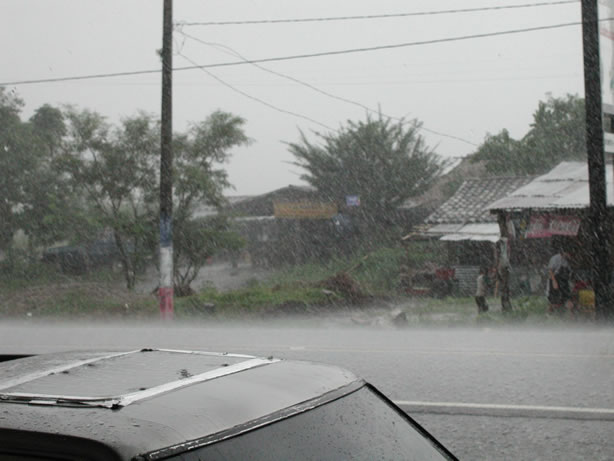 A little difficult to see, but the roofs of the houses are corrugated
metal, normally held on with logs or other heavy items. Normal homes are
one-room or two room affairs for 6 or more people. Laundry is not hung
to dry on a line, but more usually laid on trees or bushes, etc. Many
times there is no running water, and if running water certainly no hot
water. No refrigeration in most homes. If refrigeration then a small fridge
similar to what kids have in a college dorm. By the way, with the limited
amount of running water, we have no yet smelled anyone with body odor
(except ourselves after traveling all day). I don't know how it's managed
with the heat and the amount of sweat poring off everyone, but everyone
smells very nice. Back to the top.
A little difficult to see, but the roofs of the houses are corrugated
metal, normally held on with logs or other heavy items. Normal homes are
one-room or two room affairs for 6 or more people. Laundry is not hung
to dry on a line, but more usually laid on trees or bushes, etc. Many
times there is no running water, and if running water certainly no hot
water. No refrigeration in most homes. If refrigeration then a small fridge
similar to what kids have in a college dorm. By the way, with the limited
amount of running water, we have no yet smelled anyone with body odor
(except ourselves after traveling all day). I don't know how it's managed
with the heat and the amount of sweat poring off everyone, but everyone
smells very nice. Back to the top.
